VW Intake Valve Carbon Buildup
You bought your VW Golf GTI because it felt alive. Sharp off the mark, responsive through every gear, precise in a way that sets it apart. If that description sounds like a memory rather than your current experience, age probably isn’t the explanation.
There’s no dashboard warning for what’s happening… No fault code… No unusual noise. Nothing that would make you book the car in, because nothing appears to be broken.
That’s what makes this issue so easy to overlook. The change arrives so gradually that each week feels identical to the last. Months pass, and you adjust without realising it, until the car you’re driving bears little resemblance to the one you fell for.
Something physical has been accumulating inside your engine since its first cold start, and it doesn’t reverse on its own.
And that’s not all. Because a standard service doesn’t look for it, the condition can persist for tens of thousands of miles without anyone identifying the cause.
VW Golf and Tiguan models with the 2.0 TSI direct-injection petrol engine are susceptible to carbon deposits forming on the intake valves. Direct injection delivers fuel into the cylinder, not over the valves, so no fuel-based cleaning takes place. Oil vapour produced during normal engine operation coats the valve surfaces, is hardened by engine heat, and gradually limits airflow into the cylinders.
So what does this mean for the way your car drives?
In this guide, you’ll uncover the cause of VW intake valve carbon buildup, the symptoms it creates, which VW models are affected, and how a trained specialist can strip the deposits away and return the engine to the condition it was built to deliver.
What Makes VW TSI Fuel Delivery Different?
To understand why carbon collects on the intake valves, you need to look at how fuel reaches the combustion chamber.
Most older VW petrol engines fed fuel into the intake manifold, positioning it just behind the intake valves. Each intake stroke carried a fine spray of fuel across those valve surfaces before it entered the cylinder. Detergent chemicals within the fuel kept the valves scrubbed clean as a side effect of normal operation, with no dedicated mechanism required.
That pathway was redesigned for the VW TSI engine. High-pressure injectors deliver fuel directly into the combustion chamber, and the intake valves are left out of the loop. That rerouting is intentional. Sending fuel straight to the point of ignition gives the engine more granular control over combustion timing and mixture strength, which is central to the performance identity of the Golf GTI and Tiguan.
Here’s why it matters…
The intake valves no longer receive any fuel contact. Air flows past them on every intake stroke, but air can’t dissolve or dislodge the residue that begins to gather there. Across years and tens of thousands of miles, what was a clean metal surface becomes something very different.
Why Do VW Intake Valves Collect Carbon Over Time?
Picture the back of an intake valve on a brand-new engine: polished, smooth, with nothing clinging to the surface. Now picture that same valve after years of direct-injection operation.
Here’s what happens.
During every minute your engine runs, the ventilation system recycles a small quantity of oil vapour back into the intake. On a port-injection engine, fuel mist flowing over the valves would wash that vapour away before it could bond to the metal. On a VW TSI engine, no fuel makes that journey, and the vapour settles undisturbed.
Engine heat transforms the thin oily film into a hard carbon shell. Each drive adds another imperceptible layer on top of the last.
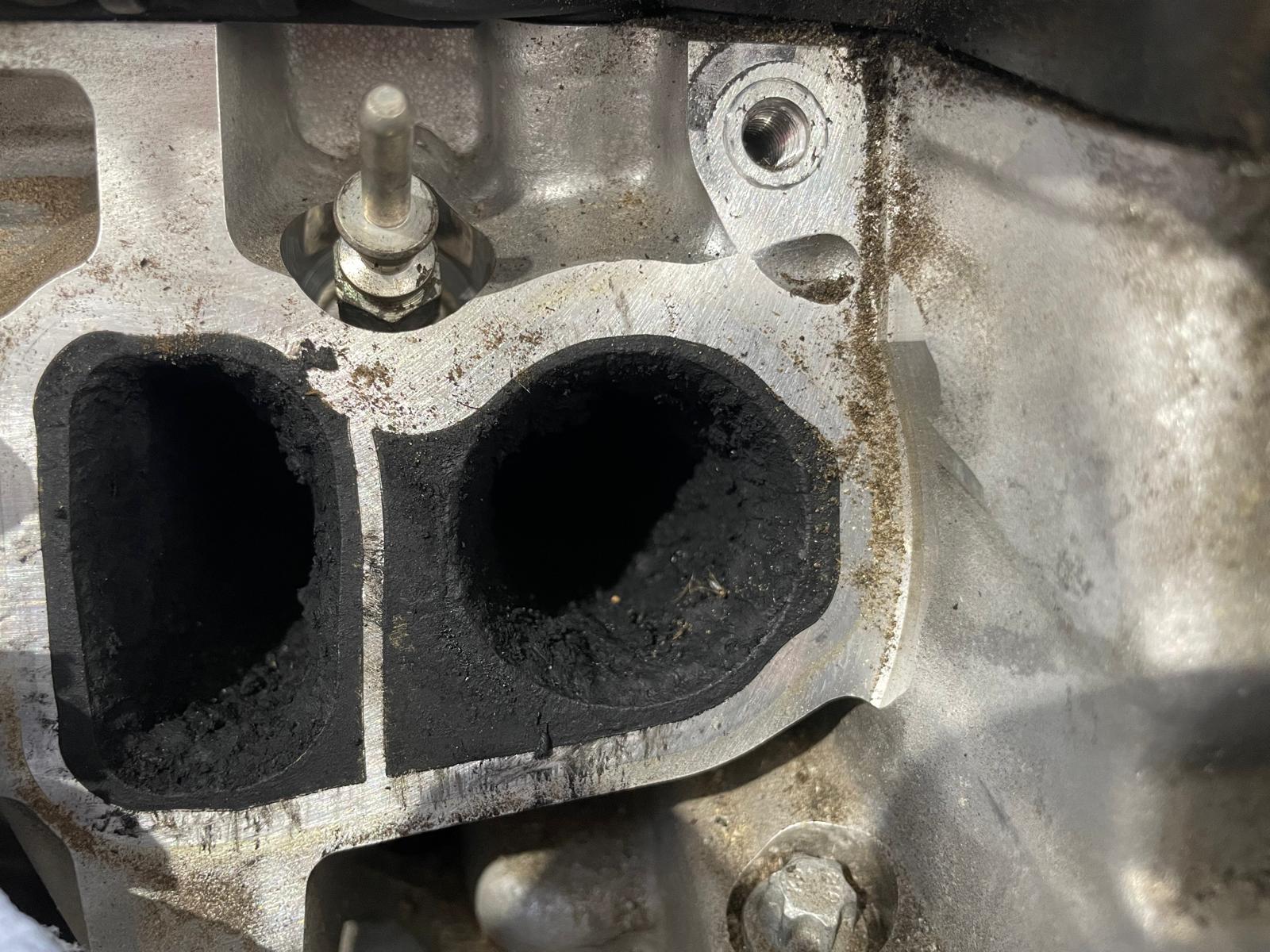
Carbon deposits accumulating inside the intake ports can restrict airflow and affect engine performance
After tens of thousands of miles, the accumulated deposit narrows the opening through which air enters the cylinder. As airflow decreases, combustion quality deteriorates, and the driver notices a measurable decline in power and responsiveness.
For VW owners in the Ystrad Mynach, Caerphilly, or Cardiff area, call Ystrad Service Centre on 01443 540460, and our team can talk you through what to check.
How VW Golf Carbon Buildup Symptoms Show Themselves
VW Golf carbon buildup symptoms develop over a long timeline, which is exactly why they get mistaken for the car losing its edge with age. If you’ve caught yourself wondering, ‘Why does my VW Golf run rough?’, deposits on the intake valves rank among the explanations worth investigating for any TSI-engined model.
So what does that actually mean day to day?
Here’s what to watch for:
- Rough idle: Most apparent during cold starts. The engine note fluctuates, or a tremor comes through the cabin that wasn’t present when the car was new.
- Delayed throttle response: Where the car once surged forward from a roundabout or a slip road, you now feel a flat spot before power builds. The pause may be brief, but it’s real.
- Diminished driving character: Golf GTI and Golf R drivers tend to sense VW Golf GTI carbon buildup before other owners, because those variants were engineered for instantaneous response. When that response softens, something in the engine has changed.
- Engine management warning light: If deposits severely restrict airflow, the engine management system may flag a warning light. By this stage, the accumulation is substantial.
Multiple unrelated faults can produce overlapping symptoms, so a clear diagnosis is essential. Our team at Ystrad Service Centre, Ystrad Mynach, can carry out a detailed technical evaluation to determine whether carbon buildup is the source of the problem.
Golf, Tiguan and the TSI Engines Most at Risk
Because the carbon accumulation pathway is a direct consequence of the fuel system design, every VW fitted with a TSI petrol direct-injection engine faces the same vulnerability. The 2.0-litre units attract the most documentation.
The most widely reported models:
- Golf GTI and Golf R (Mk7, 2013-2020)
- Golf GTI and Golf R (Mk8, 2020 onwards)
- Tiguan (2016 onwards with the 2.0 TSI)
Each of these Volkswagen models routes fuel into the combustion chamber without it contacting the intake valves, producing the same conditions for deposit formation. VW Golf GTI carbon buildup and Tiguan intake valve carbon buildup originate from the same design characteristic and are addressed through the same cleaning method.
This isn’t a VW-specific phenomenon. Direct-injection carbon deposits are documented across a broad range of vehicle manufacturers.
The catch is that VW’s TSI engines generate more discussion around this pattern because the cars are performance-oriented. Owners tuned in to how the car feels behind the wheel detect the change in responsiveness earlier than drivers of less dynamically focused vehicles.
At Ystrad Service Centre, Ystrad Mynach, we’ve worked through this pattern with VW owners across Cardiff and Caerphilly and can advise on the best course of action for your car.
What’s Involved in Cleaning VW Intake Valve Carbon Deposits?
Pour-in fuel treatments and chemical additives travel through the injector rail and into the cylinder. They don’t touch the intake valves. That’s the precise location where the VW intake valve carbon buildup accumulates, which is why no bottled product can address it. The established solution is direct mechanical cleaning.
An example of direct mechanical cleaning is walnut shell blasting.
Ground walnut-shell particles function as a precision abrasive. The granules are abrasive enough to shatter hardened carbon deposits, yet formulated at a softness that protects the valve surfaces when a trained technician controls the process.
On VW’s 2.0 TSI engine, the intake manifold must be removed before a technician can access the intake valves.
With the manifold detached, the technician positions blasting equipment to direct crushed walnut-shell media at each valve face under measured pressure. A vacuum extraction system operates in tandem, drawing away fragmented carbon and spent shell material preventing debris from migrating into the engine.
What matters is the calibre of the equipment, the rigour of the process, and the technician’s depth of experience with the TSI platform.
Once the valves are free of deposits and the manifold is bolted back with new gaskets, owners who’ve had the work completed by a specialist consistently report a revival of throttle crispness and idle composure that they had assumed was gone for good.
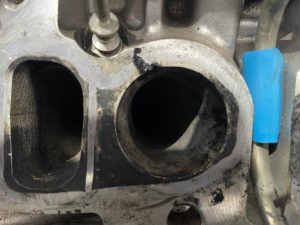
A closer look at the intake ports, showing less carbon buildup than in the heavily affected example
The process applies equally to Tiguan intake valve carbon buildup and Golf GTI deposits, since the engine and valve geometry are shared. To find out whether your VW would benefit, speak to our team at Ystrad Service Centre on 01443 540460.
Why Choose Ystrad Service Centre for VW Carbon Cleaning?
Carbon deposits on VW intake valves are invisible to a standard service checklist. Confirming its presence requires a Volkswagen specialist who understands the TSI engine’s architecture, and removing it requires controlled walnut-blasting equipment and the skill to strip and reseal the intake manifold without compromise.
At Ystrad Service Centre, Ystrad Mynach, we work with VW owners across the Cardiff and Caerphilly area.
Our expert technicians bring hands-on TSI experience and dedicated equipment to every performance investigation on Golf GTI, Golf R, Tiguan, and other Volkswagen models. Where carbon deposits are identified, we have the knowledge and tooling to restore your engine’s airflow.
Here’s what sets Ystrad Service Centre apart:
- A free courtesy car while your vehicle is with us.
- 12 months’ parts and labour guarantee on all work.
- Technicians trained and equipped to work on VW TSI engines to manufacturer standards.
- Honest, upfront communication so you know the full scope and cost before any work begins.
Join {{review-count}} local drivers across Ystrad Mynach and the surrounding area who’ve left us a {{average-rating}} Google rating, with reviews highlighting accurate repairs, specialist knowledge and honest communication.
Call Ystrad Service Centre on 01443 540460 to book your vehicle in for a technical evaluation by our experts.
Call Now 01443 540460Save on VW Servicing
Frequently Asked Questions About VW Carbon Buildup
How do I know if my VW Golf has carbon buildup?
The telltale signs of carbon buildup on a VW Golf include an uneven idle, a pause before the engine responds to throttle input, and a general sense that the car has lost the sharpness it once had. These are documented VW Golf carbon buildup symptoms. However, other faults can produce a similar picture, so a technical evaluation by a specialist with TSI engine experience is the surest route to a confirmed diagnosis.
How often does VW intake valve carbon buildup need cleaning?
There’s no universal mileage marker for intake valve carbon cleaning on a VW TSI engine. The speed at which deposits form depends on how the car is driven, the length of journeys, and how closely the service schedule has been followed. Symptoms may appear after tens of thousands of miles, though every engine is different. If your VW feels less responsive than it should, having the intake valves assessed by a specialist is the logical step.
Can fuel additives prevent carbon buildup on VW engines?
No. Fuel additives clean the injector tips and fuel rail, but on a direct-injection engine they don’t contact the intake valves. VW intake valve carbon buildup forms on surfaces that sit upstream of the fuel spray, well beyond the reach of any additive. Once the deposits have solidified, the established removal method is mechanical cleaning carried out by a specialist technician with dedicated blasting equipment.
How much does VW intake valve carbon cleaning cost?
VW intake valve carbon cleaning is quoted per vehicle, based on deposit severity and the overall condition of the intake system. Our team at Ystrad Service Centre, Ystrad Mynach, is the smart alternative to the main VW dealer. Call us on 01443 540460, and we’ll walk you through the process and provide an upfront price.