How Does Car Suspension Work?
You’re heading along a familiar stretch of road through Ystrad Mynach when the nearside wheel catches a pothole. A dull thud rises from underneath your car, something that wasn’t there a few weeks ago.
You slow down and listen… Nothing.
A speed bump further along, and the same clunking sound comes back… firmer this time.
It’s not loud or overly alarming, but it’s there all the same, and now you can’t stop listening out for it.
That type of noise is worth taking seriously.
It can be a sign that one of the suspension parts underneath your car has started to wear, and because this kind of deterioration builds gradually over weeks and months, it’s easy to adapt to how the car feels without recognising how much has changed.
Your car’s suspension connects the wheels to the body and helps control how the vehicle responds to uneven road surfaces, keeping the cabin stable and the tyres in contact with the road. It’s made up of several components, including springs, shock absorbers, control arms, and bushings, each of which wears gradually, which means issues can develop without a sudden warning.
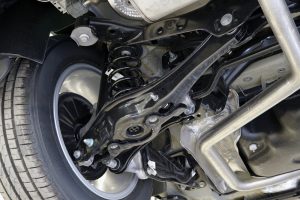
Your car’s suspension uses a combination of springs, shock absorbers, control arms and other components to keep the vehicle stable and the tyres in contact with the road
If you’ve been asking “How does car suspension work?”, this guide has the answer.
It covers what each part does underneath your vehicle, how wear develops over time, and the signs that something needs checking. Whether you’ve had an MOT advisory, picked up on a noise, or want to understand your car before calling a garage, this is where to start.
What Does Car Suspension Do?
So, how does car suspension work? It begins with the job the system was built for.
Roads aren’t always smooth; potholes, raised drain covers, expansion joints, and uneven tarmac are part of everyday driving. Without suspension, every one of those imperfections would pass directly from the wheels into the body of the car and straight through to you.
The suspension system sits between the wheels and the car’s body. It manages how the vehicle responds to the road beneath it, presses the tyres against the surface, and keeps the cabin stable enough for you to steer, brake, and drive with confidence.
So what does car suspension do?
Your suspension does three things, all at once:
- Road Impact Control: Each time a wheel passes over a bump, the suspension compresses to absorb and soften the force before it reaches the cabin.
- Tyre Contact: The system keeps the tyres firmly pressed to the road, even when the surface beneath them changes, so braking and steering remain effective.
- Stability: It controls how much the car leans in bends, how far the nose drops under braking, and how much the rear dips when you accelerate.
When all three are working as they should, your suspension operates in the background. Most drivers don’t give it a thought until something shifts.
As components begin to wear, the system’s grip on those three tasks weakens, and that’s when car suspension problems and symptoms start to show from behind the wheel.
Springs, Shock Absorbers, and How They Work Together
Coil springs compress as the wheels travel over uneven surfaces, helping absorb road impacts before they reach the cabin
Several parts make up your suspension, but coil springs and shock absorbers handle the lion’s share. They work together as a pair, and once you understand how each one contributes, the rest of the system becomes easier to follow.
Coil Springs: Fitted to most modern cars, coil springs compress when a wheel meets a bump and then extend to return the wheel to its resting height. That compression takes the initial force out of the road impact before the shock absorber steps in to manage the motion that follows.
However, coil springs don’t last forever. Wear sets in over the months and years, and they can gradually lose height, develop cracks, or, in some cases… give way altogether.
A spring that’s dropped in height may cause one side of the car to sit visibly lower than the other. A cracked or broken spring is one of several components that can generate a knocking sound when you drive over bumps, and it’s a well-documented MOT failure point.
So what prevents the car from continuing to bounce after every bump? That’s the shock absorber’s job.
Shock Absorbers: Also called dampers, they control how the spring behaves after it compresses. Oil is forced through a set of internal valves as the suspension cycles up and down, and that resistance slows the movement, preventing the car from bouncing repeatedly. When shock absorbers wear out, you may notice the car swaying over bumps, the front dipping sharply under braking, or driving around bends feels less stable than it used to.
In many modern vehicles, these two components are packaged together.
MacPherson Struts: This design combines the coil spring and shock absorber into one unit called a strut. It’s common across many vehicles, particularly front-wheel-drive models. The spring sits around the shock absorber body, and the entire assembly also forms part of the steering and suspension geometry. Where struts are fitted, repairs are carried out on the full assembly rather than treating the spring and shock absorber as individual parts.
Not every vehicle follows this layout, however.
Some models, particularly those in the premium or performance market, use a double-wishbone or multi-link arrangement in which the spring and shock absorber are mounted separately.
If you’ve noticed your car bouncing more than it used to, less confidence through corners, or the front dropping when you brake, it’s worth having the springs and shock absorbers checked.
Our team at Ystrad Service Centre, Ystrad Mynach, can assess these parts and let you know what needs attention.
What Control Arms, Bushings, and Anti-Roll Bars Do
Coil springs and shock absorbers manage the vertical movement, but your suspension also needs to hold each wheel in its correct position and keep its alignment true. That falls to control arms, bushings, and anti-roll bars.
- Control Arms: These are the metal links connecting each wheel hub assembly to the car’s chassis or subframe. They allow the wheel to travel up and down over bumps while anchoring it in the correct geometric position. When the bushings or ball joints inside a control arm deteriorate, the wheel geometry can shift, and that feeds through into how the car steers, brakes, and wears its tyres.
- Bushings: At every connection point where a control arm meets the chassis or the hub assembly, a rubber bushing sits between the metal surfaces. Its role is to absorb vibrations, suppress noise, and allow controlled flex between moving parts. When bushings wear through, they become one of the most recognised causes of a knocking sound when you drive over bumps, especially at lower speeds. You may also notice the steering feeling less direct, or your car pulling to one side, though a pull can also stem from tyre pressures, alignment settings, or a brake issue.
- Anti-Roll Bars and Drop Links: Running from one side of the car to the other, anti-roll bars tie the left and right suspensions together. Their purpose is to reduce how much the body leans when you corner. Short connecting pieces called drop links attach the bar to the suspension at each end.
Drop links wear on a regular cycle and are one of the most recognised items during an MOT.
A deteriorated drop link can generate a rattle or knocking sound over uneven road surfaces. Where the ball joints develop excessive play or the protective dust cover has degraded enough to allow dirt into the joint, the result can be an MOT advisory or a fail, depending on severity.
If you’re hearing a knocking sound when you drive over bumps, noticing uneven tyre wear, or the car doesn’t feel as precise as it once did, control arms, bushings, or drop links could be among the causes.
Getting these assessed early is worthwhile. Contact Ystrad Service Centre, Ystrad Mynach, on 01443 540460, and we’ll walk you through what to do next.
What Is Air Suspension and Why Does It Fail?
A number of premium vehicles feature air suspension rather than standard coil springs. In place of a metal spring at each corner, these systems use pressurised airbags that inflate and deflate to carry the vehicle and manage its ride height. Damping is still provided by shock absorbers, as in a conventional system.
In more advanced systems, the car can adjust its height while you drive, with a compressor supplying air to each airbag and electronic controls balancing the pressure at all four corners. The system responds to speed, road conditions, or driver-selected settings to keep the vehicle level.
The most recognisable sign of air suspension trouble is the car dropping on one corner or sitting unevenly after being left standing. This generally points to a leak in one of the airbags or to a malfunction in the valve block that directs air where it’s needed.
An airbag that’s leaking forces the compressor to cycle more to compensate for the lost pressure, and that added workload can accelerate wear on the compressor over time.
When it comes to repairs and maintenance, air suspension is specialist territory. The systems are electronically controlled; the parts vary from one vehicle to the next, and tracing a leak requires experience and the right tooling.
If your vehicle has air suspension and something about how the car sits or handles doesn’t feel right, it’s worth having it assessed by an expert.
The Signs That Your Suspension Is Wearing
Suspension wear doesn’t arrive suddenly. It accumulates gradually, and because you’re behind the wheel day after day, the slow shifts in how the car rides and handles blend into your normal driving experience.
So, what does worn suspension feel like when you’re driving? Here are some common signs of worn suspension worth watching for:
- Clunking or Knocking: A noise each time you drive over bumps, speed bumps, or turn at lower speeds. Deteriorated bushings, worn drop links, a cracked or broken spring, or other suspension components can all be responsible.
- The Car Pulling or Drifting: Without any steering input from you, the car drifts to the left or right. Worn bushings or control arm joints that have altered the wheel geometry are one possible explanation, although tyre pressures, alignment, and brake-related factors can equally be responsible.
- Uneven Tyre Tread Wear: One edge of the tyre wearing down more than the rest, or tread depth varying across the axle, can be a sign that suspension deterioration has shifted the wheel angle from its correct position.
- A Visible Lean to One Side: If the car sits lower on one corner, a spring that’s sagged or broken could be the cause. On cars with air suspension, a leak in the system can produce the same effect.
- Excessive Lean Through Corners: The body rolls further than it used to when you corner, or driving around bends feels less stable than you remember.
- The Nose Dipping Under Braking: When the front of the car drops more than expected as you slow down, it can indicate that the suspension isn’t distributing weight transfer effectively. Worn shock absorbers are one possible contributor.
These are some of the most common car suspension problems and symptoms, and they can overlap.
More than one component can contribute to the same sensation you feel from behind the wheel, which is why having the entire system assessed by an expert is a better approach than trying to isolate individual parts.
If any of this sounds familiar, get in touch with Ystrad Service Centre, Ystrad Mynach, and we can check it over for you.
How Suspension Wear Shows Up on Your MOT
A suspension check is part of every MOT. Where wear or deterioration has reached a point that affects safety, the result is either an advisory or a failure.
Your car’s ball joints, springs, gaiters, bushings, drop links, and shock absorbers are the suspension components picked up most during MOTs. Each is assessed for excessive play, damage, and deterioration, and anything that exceeds an acceptable limit gets recorded.
An MOT is a legal requirement for all UK vehicles over three years old. It captures a single-day snapshot of your car’s roadworthiness, the legal minimum rather than a thorough health check.
So, if “how long does car suspension last” is something you’ve been wondering, it’s worth noting that there’s no specific answer; it varies depending on a number of factors. Scheduling checks at regular intervals, especially around MOT time, is the most effective way to stay ahead of wear before it progresses.
If suspension advisories have shown up on previous MOTs, having those items assessed before the next test is a sensible step rather than waiting for them to reappear.
Why Getting an Expert to Check Your Suspension Matters
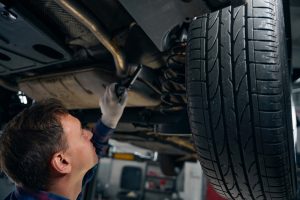
A thorough suspension assessment helps pinpoint worn components and identify the cause of knocking, pulling or changes in handling
Suspension symptoms don’t point to one single component with certainty. A knocking sound each time you drive over an uneven surface could stem from a bushing, a drop link, or a fractured spring. A pull to one side might trace to a control arm, a degraded bushing, or something unrelated to the suspension.
Pinpointing the actual source before any parts are ordered is what separates a repair that works from one that doesn’t. Fitting the wrong component leaves the original problem untouched, along with the cost.
A garage with suspension expertise will look at the system as a whole, examining how each component interacts with the others, tracing the wear to its true origin, and explaining everything clearly before recommending any work.
Now that you have the answer to “How does car suspension work?” and a clearer picture of the parts underneath your vehicle and how they wear, you’re in an informed position the next time you speak to a technician. You’ll know what to ask, and you’ll understand the answer when you hear it.
Why Choose Ystrad Service Centre, Ystrad Mynach, for Your Suspension?
Knowing how your suspension works and where wear develops puts you in a better position when it’s time to have things checked. The next step is finding somewhere that can inspect the entire system and carry out any work to a high standard.
Suspension deterioration tends to build over time, and when it’s caught early, many issues can be addressed before they progress further, begin affecting neighbouring components, or result in an MOT failure.
At Ystrad Service Centre, Ystrad Mynach, our technicians have the experience and equipment to assess your full suspension system, locate areas of wear, and carry out all repairs to a high standard.
By choosing Ystrad Service Centre, you benefit from:
- Expert technicians working on your vehicle.
- A 12-month parts-and-labour guarantee on all repairs carried out.
- A free courtesy car while your vehicle is with us.
- A clear explanation of what’s been found before any work begins.
Join {{review-count}} other drivers across Ystrad Mynach, Caerphilly, and Cardiff who’ve given us a {{average-rating}} rating for accurate repairs, honest service and excellent value.
Whether you’ve noticed a strange noise, had an MOT failure or advisory, or want your vehicle’s suspension system checked, call Ystrad Service Centre, Ystrad Mynach, on 01443 540460, and book an expert suspension inspection.
Our team will assess your car’s suspension system and let you know where things stand.
Frequently Asked Questions
How does car suspension work?
Your car’s suspension sits between the wheels and the body of the vehicle, managing how the car handles the road surface beneath it. Coil springs compress to soften the force of bumps, while shock absorbers control the spring’s movement afterwards to prevent the car from bouncing. Control arms and bushings hold each wheel in its correct position as the suspension cycles up and down. When all these parts work as they should, the car feels planted, predictable, and comfortable.
What does car suspension do?
Your car’s suspension connects the wheels to the body, handling how the vehicle responds to uneven road surfaces. It holds the tyres against the tarmac, controls how far the body rolls through bends and dips under braking, and helps maintain a ride that feels stable and composed. As parts within the system deteriorate, changes in steering feel, ride comfort, or handling can begin to appear.
What are the signs of worn suspension?
Signs of worn suspension include a knocking or clunking sound when you pass over bumps or turn at low speed, the car pulling to one side without steering input, uneven tyre tread wear, one corner of the vehicle sitting lower than the rest, and the body leaning further than usual through bends. These changes tend to develop gradually, so it’s worth having an assessment if the car doesn’t feel the way it used to. Our team of experts at Ystrad Service Centre can check it for you.
How long does car suspension last?
The lifespan of car suspension varies. How long each component lasts depends on driving habits, the condition of the roads you drive on, mileage, and the specific part in question. Some parts wear sooner than others, and identical components can last very different lengths of time on different vehicles. Regular checks, especially around MOT time, are the best way to catch wear before it advances or starts affecting how the car handles.
Can worn suspension cause an MOT failure?
Yes, worn suspension can cause an MOT failure. Excessive play in ball joints, cracked or broken springs, split gaiters, deteriorated bushings, and worn drop links are all items that an MOT inspection can flag, and each can lead to a failure where the wear is significant. If a suspension advisory appeared on your last MOT, having it checked before the next test is a sensible move.