Land Rover DPF Fault Diagnosed
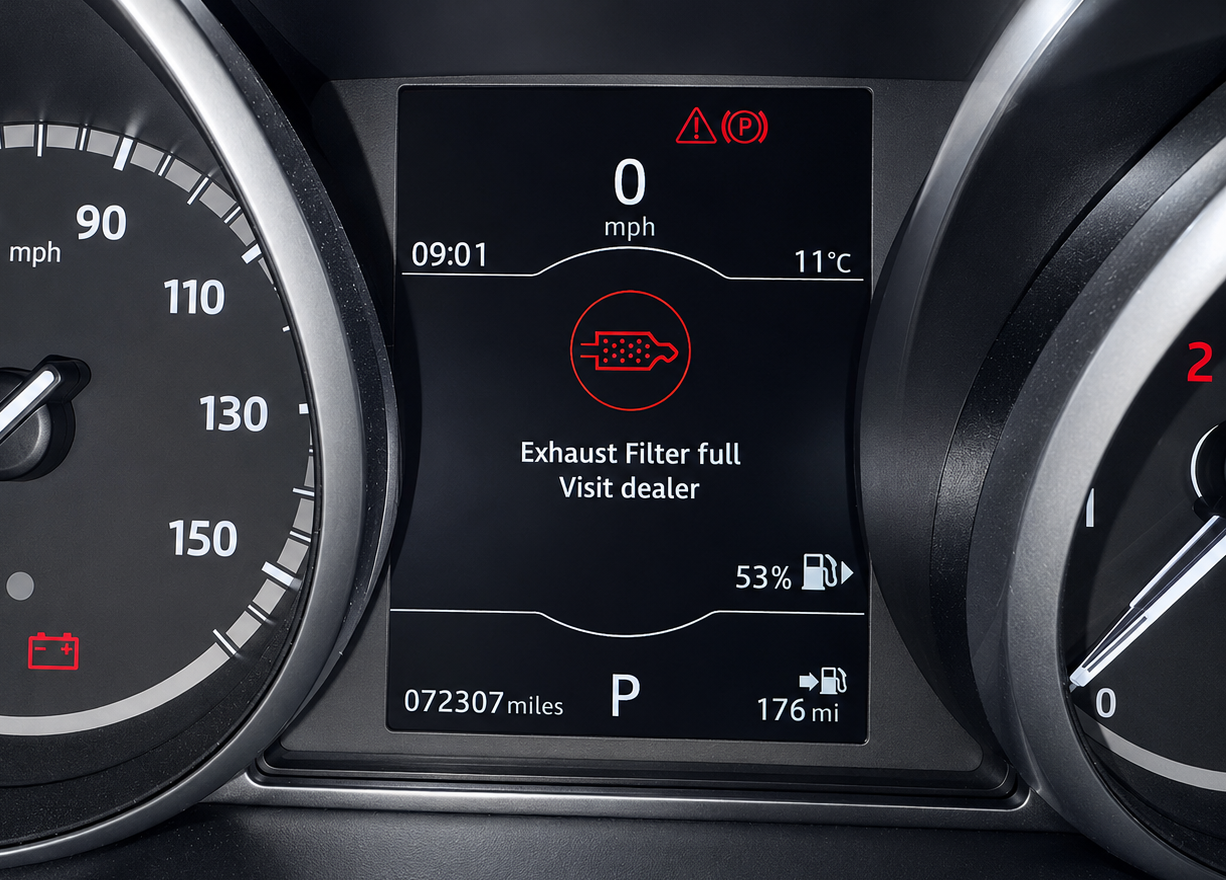
It came out of nowhere. Mr J’s 2017 Land Rover Discovery Sport had been running as expected, and then, mid-journey, warning lights filled the dashboard, the engine experienced a reduction in power, and dropped into limp mode.
That sudden change would unsettle any driver. Was the vehicle still safe to use? What had caused the warning lights to appear? And was the fault going to get worse the longer it was left?
Mr J, from the Walsall area, contacted Ystrad Service Centre, Ystrad Mynach, looking for answers. His Discovery Sport was presenting clear blocked DPF symptoms, and it was obvious the underlying cause needed to be found and dealt with properly, not simply cleared and left to chance.
He needed a garage with the technical ability, the correct equipment, and a methodical approach to trace the fault and carry out the right repair. Mr J booked his Discovery Sport in with Ystrad Service Centre for a detailed technical evaluation.
What Did Our Initial Assessment of the Blocked DPF Symptoms Reveal?
Once Mr J’s Discovery Sport was at Ystrad Service Centre, Ystrad Mynach, our starting point was to sit down with him and understand the full picture. We asked when the warning lights had first come on, how the vehicle had behaved since, and whether there had been any recent changes to his usual driving routine.
Short, stop-start journeys are one of the most common reasons DPF problems develop. Without sustained engine temperatures, the regeneration process cannot complete as it should. Establishing how Mr J typically used his vehicle was a key part of the assessment before any hands-on testing took place.
With that background gathered, our technicians connected the Discovery Sport to our dealer-level diagnostic equipment and carried out a full system scan. Two stored fault codes stood out as directly relevant to the DPF concern:
- Land Rover P2463 fault code — P2463-00, indicating the engine management system had flagged excessive soot loading or restriction in the diesel particulate filter.
- Land Rover P246B fault code — P246B-00, indicating that the conditions needed for DPF regeneration were not being consistently achieved, or that regeneration cycles had been interrupted before completing.
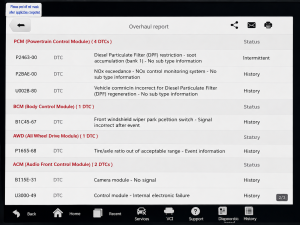
Both codes were consistent with DPF issues, but on their own they only provided a partial picture. To determine exactly what had triggered the DPF warning and stored fault codes, and to make sure the correct repair was carried out, a deeper inspection was necessary.
From there, our technicians moved into a structured, step-by-step investigation to identify the root cause with certainty.
What Was Behind the Land Rover DPF Fault?
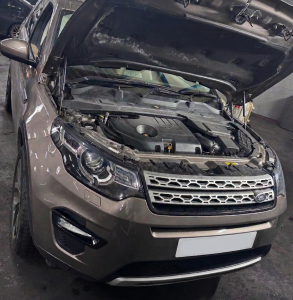
The initial scan had confirmed excessive soot in the DPF and that regeneration was failing to complete. But our technicians needed to understand why the filter had reached that state before any repair could begin. A Land Rover DPF fault can develop for a number of different reasons, and the correct fix depends entirely on establishing the specific cause. Each potential factor was assessed in turn, with one eliminated before the next was checked.
Step 1: External DPF Inspection
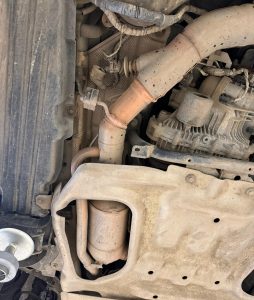
The first check was to confirm whether the DPF was still structurally intact. A cracked or damaged filter substrate would change the repair approach entirely, potentially requiring replacement rather than cleaning.
- The DPF housing and surrounding components showed no signs of physical damage or failure.
- This indicated the filter was likely suitable for cleaning rather than replacement.
Step 2: Oil Level, Condition, and Oil Dilution Check
The engine oil level and condition were assessed next, with close attention paid to whether oil dilution had occurred. Oil dilution develops when DPF regeneration attempts fail to complete. During a regeneration cycle, the engine management system introduces additional fuel through late post-injection to raise exhaust gas temperatures. If that cycle does not finish, some of the fuel can wash past the piston rings and enter the engine oil rather than being burnt off through the exhaust.
- Our technicians found clear evidence of fuel dilution in the engine oil.
- Diluted oil degrades over time and can affect overall engine condition. At the same time, the repeated failure to regenerate meant soot had no route out of the DPF, and the accumulation kept growing.
With oil dilution now confirmed, our technicians carried on with the inspection to establish whether any other factors were contributing.
Step 3: Air Filter Condition Check
The air filter was assessed next. A restricted air filter reduces the volume of air reaching the engine, which can lower combustion efficiency and increase particulate production. This increases the volume of particulates produced and places a greater load on the DPF over time.
- The air filter was found to be in good order and was discounted as a factor.
Step 4: DPF Pressure Readings
Our technicians measured the differential pressure across the DPF using dealer-level diagnostic equipment.
- The readings were high, confirming the filter was carrying a heavy soot load.
- This was directly in line with the Land Rover P2463 fault code recorded during the initial scan.
Step 5: Boost Leak Assessment
The intake and boost system was inspected for leaks. A boost leak reduces combustion efficiency and can accelerate the rate at which soot loads the DPF.
- No boost leaks were found.
With every area now thoroughly checked, the root cause was clear. The DPF had been unable to regenerate, and soot had built up progressively in the filter over time. The oil dilution identified during the inspection was a direct consequence of repeated failed regeneration attempts. That accumulation had eventually reached the point where the dashboard warning lights were triggered, the vehicle was forced into limp mode, and power dropped away significantly.
Testing confirmed no sensor or hardware faults that would have prevented regeneration from completing, pointing to driving conditions and interrupted regeneration cycles as the most probable cause.
How Was the Land Rover DPF Fault Repaired?
With the root cause now established, our technicians got in touch with Mr J to explain the findings and set out the recommended repair. Once he was happy to proceed, the work got underway.
Engine oil and filter change
The engine oil had become fuel-diluted as a result of repeated failed regeneration attempts and was no longer providing adequate engine protection.
- The diluted oil was fully drained and a complete oil and filter change was performed.
- The replacement oil met the correct Land Rover specification for the Discovery Sport’s Ingenium diesel engine, applied in line with manufacturer standards.
Diesel particulate filter cleaning
With fresh oil now in the engine, attention moved to the DPF. The filter had already been confirmed as structurally sound during the earlier inspection, so diesel particulate filter cleaning was carried out to reduce the soot load and restore flow through the filter before performing regeneration.
Forced DPF regeneration and system reset
After the cleaning was complete, a service regeneration was initiated using the manufacturer-level software.
- Following the regeneration, relevant DPF adaptation and soot loading values were reset in accordance with manufacturer procedures, ensuring the engine management system could accurately monitor the filter following cleaning and regeneration.
- The fault memory was cleared and the system retested. No new fault codes were stored.
Customer guidance
On the Ingenium diesel engine, frequent short journeys can prevent DPF regeneration from completing. When regeneration is interrupted, fuel introduced through late post-injection, intended to raise exhaust temperatures for regeneration, can wash past the piston rings. Over time, this leads to oil dilution.
- Our technicians talked Mr J through this and explained the driving habits that would help support the DPF regenerating correctly going forward.
The Difference After the Repair: DPF Regeneration Issues Cleared
Mr J’s 2017 Land Rover Discovery Sport left Ystrad Service Centre, Ystrad Mynach, in a completely different state to how it had arrived. Full power had been restored, every dashboard warning light had cleared, and the vehicle was running smoothly with no sign of limp mode. The blocked DPF symptoms that had brought it in were fully resolved.
What made the repair effective was the focus on what was actually causing the problem. The diluted oil was replaced to safeguard the engine, the soot load was reduced, and a controlled regeneration returned the DPF system to correct operation. Every contributing factor had been properly addressed, not just the most obvious symptom.
Mr J also left with a thorough understanding of how the DPF system in his Discovery Sport functions, the role his driving habits had played in the fault developing, and clear steps to help avoid DPF regeneration issues recurring in the future. That kind of knowledge makes a real difference; a driver who knows what to look for is far less likely to face the same problem again.
The result was a first-time resolution, carried out at a more competitive price than a main dealer, with honest and straightforward communication at every stage.
Experiencing Blocked DPF Symptoms? Book a Professional Check with Ystrad Service Centre
A DPF warning light on dashboard, limp mode, and a sudden loss of power are warning signs that should not be ignored. Blocked DPF symptoms like these are rarely a standalone issue, and putting off an assessment can allow a manageable fault to develop into something significantly more expensive.
If your Land Rover has a DPF warning light on the dashboard, has gone into limp mode, or has lost power unexpectedly, an early professional assessment is the most sensible next step.
At Ystrad Service Centre, Ystrad Mynach, our technicians have the knowledge, dealer-level equipment, and technical information to identify and resolve Land Rover DPF faults accurately, the first time. By choosing Ystrad Service Centre, you benefit from:
- Dealer-level diagnostic equipment and access to Land Rover technical information.
- A 12-month parts and labour guarantee on all work carried out.
- A free courtesy car to keep you mobile while your vehicle is with us.
- Competitive independent garage pricing with no compromise on quality.
Call 01443 540460 today to book your assessment and get your Land Rover back to its best. Whether it’s a DPF warning light on dashboard, limp mode, or reduced performance, we’re ready to help.